Bleep
Find where sensitive speech is, without transcribing what was said.
A small frame-tagging model that reads audio and outputs
(category, start, end) — a spoken digit string here, a
letter-by-letter spelling there — and nothing else. It never produces a
transcript, and it has no mechanism that could: the network takes log-mel
features and emits nine per-frame channels.
This is a published negative result
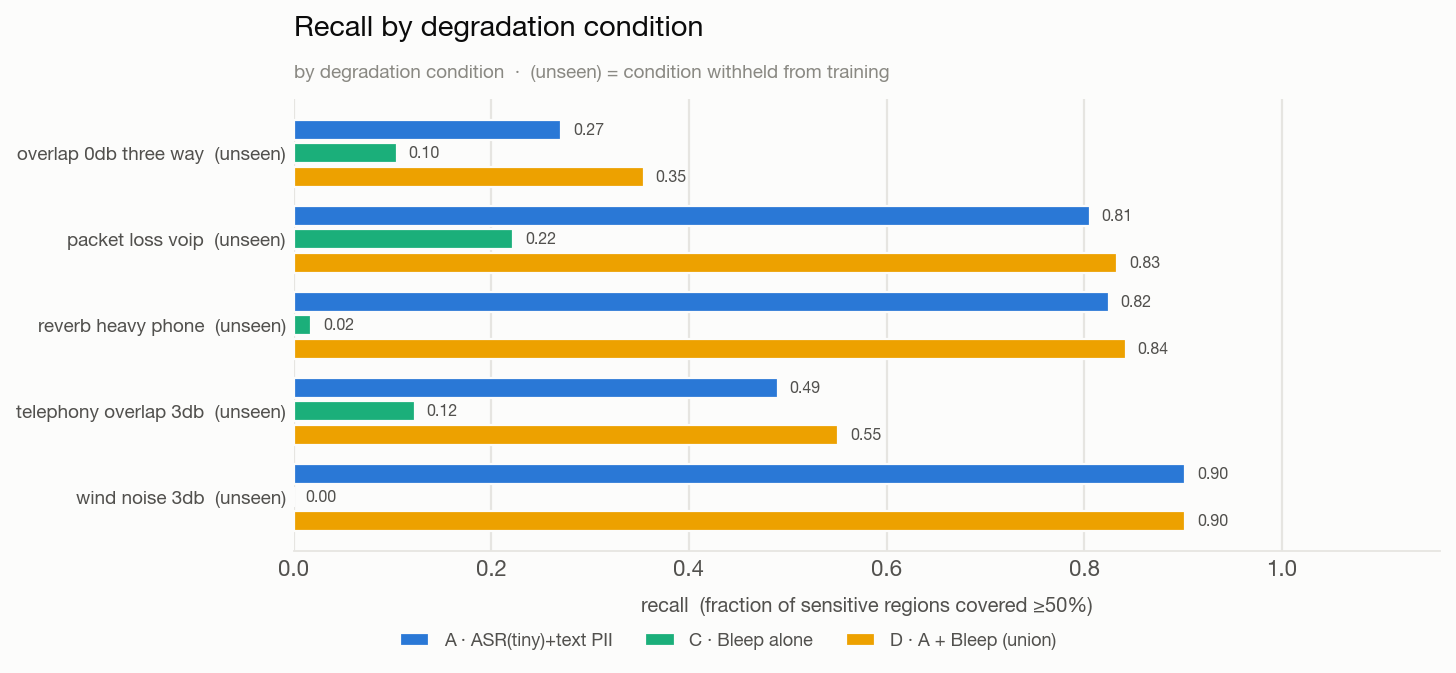
At the ASR baseline's own measured false-alarm rate, on a speaker-disjoint test split, Bleep loses badly. That is the finding, and it belongs at the top rather than in a footnote.
Why, specifically
The benchmark was built to separate the reasons, not just report the number.
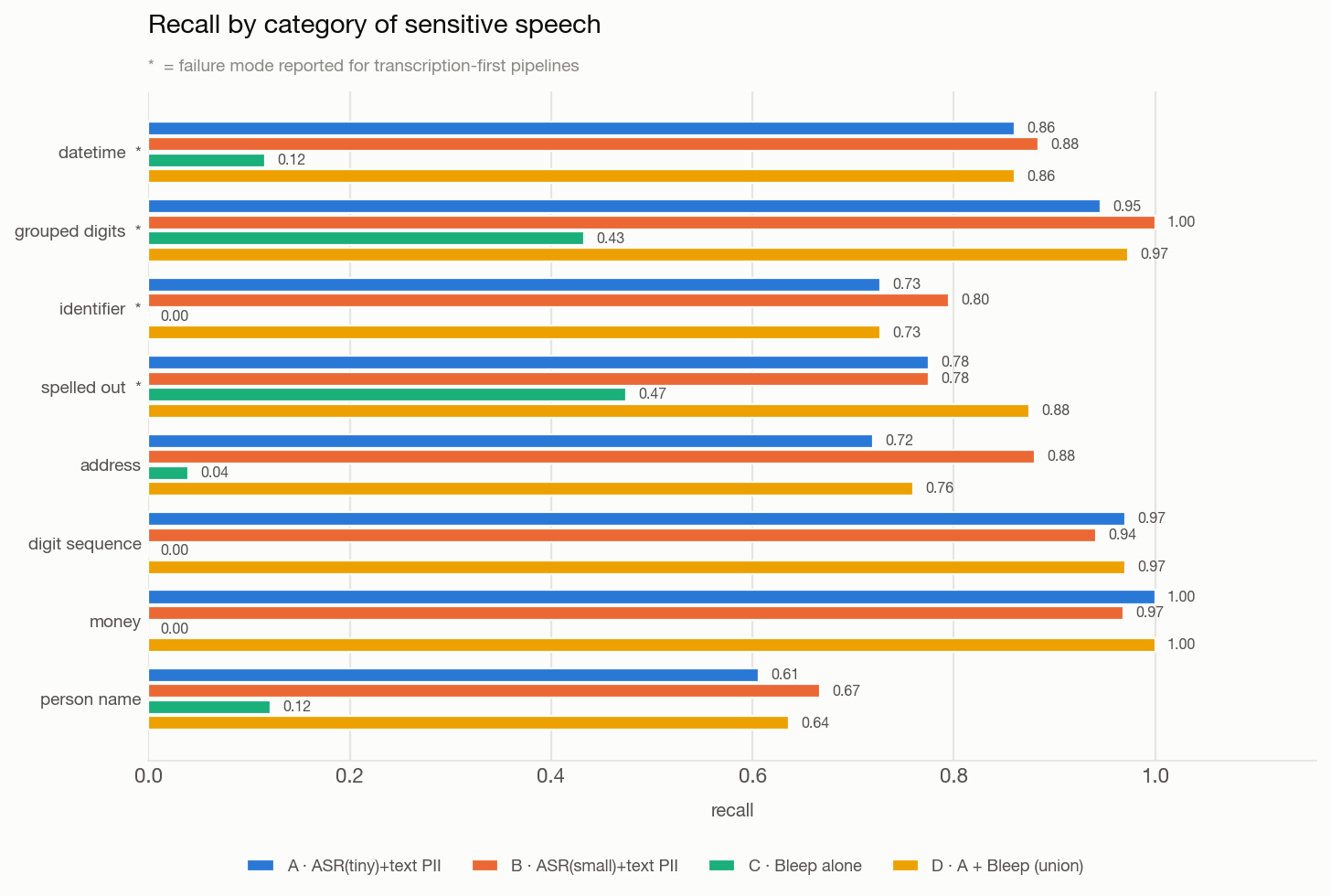
1 · The failure mode is real, but the corpus put it in the wrong place
…
2 · The text rules were never the bottleneck
An oracle arm — a perfect transcript fed to the same text-PII rules — scores 0.96–1.00 in every condition. So every baseline miss is an ASR word error rather than a detector gap. That one arm turns “the baseline failed” into “the baseline failed here, for this reason”.
3 · The model is badly undertrained
1500 steps, batch 4, ~1.8 epochs over 9.15 hours — 70 minutes on one consumer GPU. Validation loss was still falling monotonically at the final step (0.218 → 0.183): a stopped run, not a converged one.
One directional hint
…
What did hold up
…
Timeline viewer
Real utterances from the test split. Ground truth against what each detector actually found, at the operating points the benchmark reports.
No audio is shipped. These recordings were rendered with the macOS system voices, which are licensed for use and not for republication as a corpus. What you see is a downsampled amplitude envelope — a few hundred numbers per utterance, enough to draw a waveform, not enough to reconstruct speech.
Recall by degradation condition

Recall by category
What this is not
Not a redaction guarantee. It misses most things. An empty result means “nothing was flagged”, never “nothing is there”.
Not a replacement for your ASR-based detector. It is designed for union mode, and the union is proven never to drop a region the existing detector found — zero violations across both splits.
Not trained on real audio. Every recording is synthetic. No real call, no clinical recording, nothing derived from either, at any stage. That is also a limitation: TTS speech is far easier to transcribe than conversation, which is part of why the baseline looks so strong here.
…
Apache-2.0. Negative results are cheap to hide and expensive to rediscover.